

- This event has passed.
A Double Bill: SITA & ABDUCTED
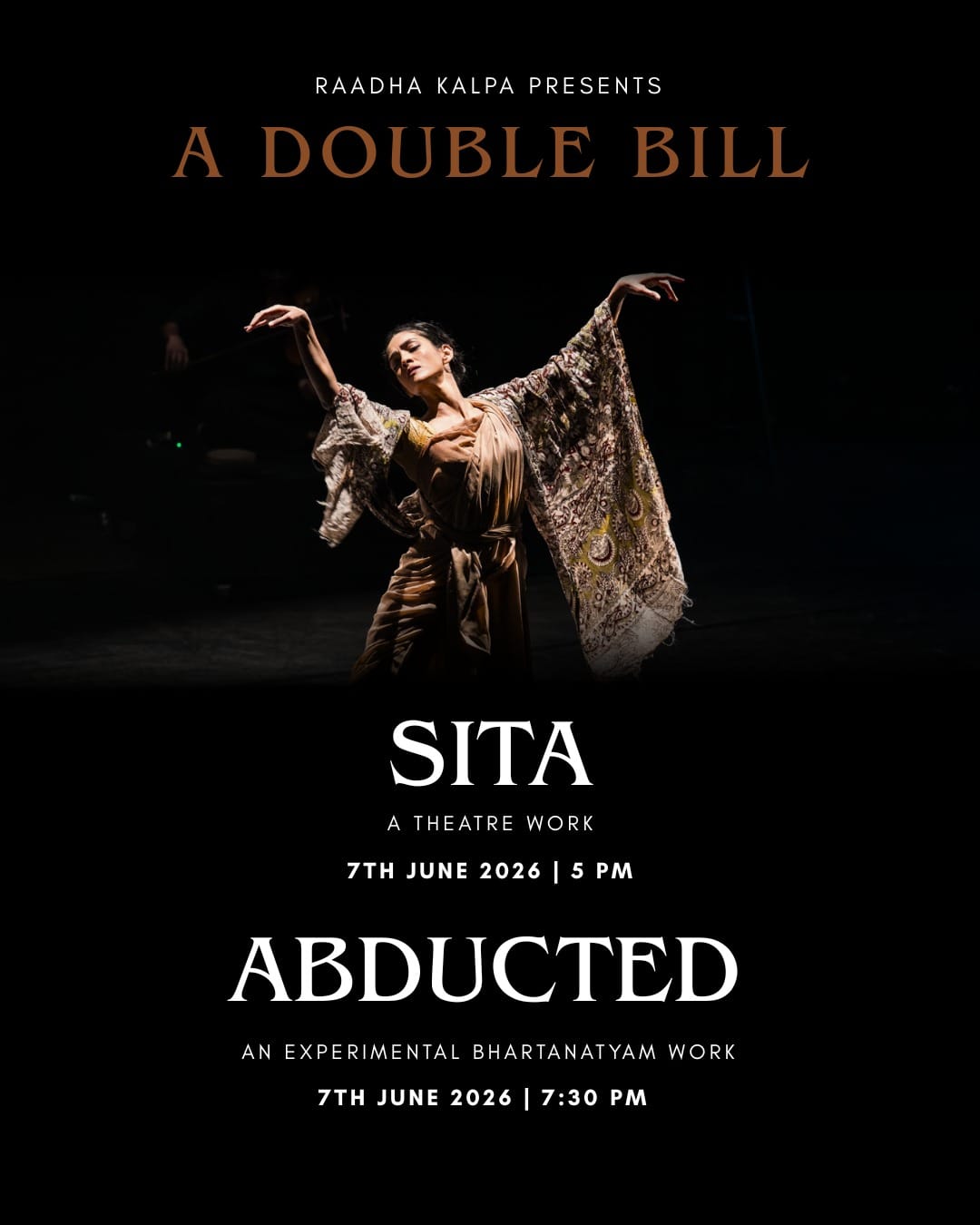
SITA
A Solo theatre work.
What if Sita told her own story? Not the myth as remembered by history — but the woman as she lived it.
SITA is an intimate, experimental solo production that weaves Bharatanatyam, spoken word, theatre, and improvisation into a deeply personal retelling of the Ramayana — from Sita’s point of view..
This is not the Sita of idealised silence or distant virtue. This is a woman in love, in laughter, in longing, in doubt. A wife who saw the man behind the king. A mother raising her children alone. A voice that remembers tenderness as vividly as loss.
The performance moves fluidly between present memory, imagination, and lived past, allowing movement and speech to overlap, interrupt, and converse with one another. While the structure is defined, the work remains alive and improvisational, responding to breath, memory, and moment.
At its heart, SITA is about love that was real — and the cost of doing what is “right.”
Abducted
The female body is physically weaker than the male body. It is easily dominated by virtue of inherently not possessing the same amount of strength as a man. A woman’s body is projected as an object of desire repeatedly through centuries by societies. The image of a submissive, helpless woman is repeated through history, across cultures. It is an image that is used to sell commercial merchandise repeatedly.
A woman almost always feels a sense of helplessness in situations of physical confrontation with a man. ‘Abducted’ is inspired by stories of abduction and abuse from India and around the world. The act of abusing someone indicates an incapacity to consider another human. It is a desire with no boundaries. Populations have begun to come to terms with degrees of abuse that exist in many forms and shapes. What have we done as societies to cultivate this kind of culture? The position of women has constantly been a point of contention at work, in homes, in politics, in the field of education etc. The representation of a physically strong woman in the modern world, in films and comics is often attached to the physical objectification of women; but a powerful woman in the workplace is shown wearing a suit with hair slicked back. Can we represent strength and power in a female body without objectification, while also embracing the feminine?
One of the only archetypes of power, carried in a female body is the image of the Indian goddess, Kali. Kali is embraced as a figurative female energy that holds within herself the ability to annihilate evil and rejuvenate life. She is the keeper of time and space. This particular image has no objectification of the female body attached to it. Kali is sensual, but does not cater to the male gaze as a sexual object. She is also not ‘pure’ in the sense of being devoid of sexual energy.
At which point does the abuse of power bring out the Kali in us. At which point does a woman’s desire materialise? When does she wield her power, strength and take charge of her sexuality? “